
 Visit our High Wycombe Store
 All items in Stock in our High Wycombe Store
 01753 299 777
 Are BB Guns Toys? The Reality of UK Airsoft Law in 2026
25
Sep
Reading Time: 4 Minutes
Last edited: 11:07 Thursday 25th June 2026
It’s a scenario that plays out every single week across the UK. You’re deep in an online rabbit hole, browsing for your very first airsoft starter kit, or perhaps you're a parent trying to find the ultimate birthday gift for a teenager. Suddenly, you stumble upon a stunningly detailed, weight-correct replica of a legendary firearm—maybe an apex-tier Heckler & Koch MP5 or a classic Colt .45. It looks spectacular, feels authentic, and right on cue, that nagging question pops into your head: "Is this just an expensive toy?"
It’s an entirely natural question. But if you point that question at the British legal framework, the answer you get back isn't just a simple "no"—it is a high-stakes, heavily legislated reality check.
Let’s slice through the online myths and backyard rumors immediately: under UK law, BB and airsoft guns are absolutely not classed as toys. Treating them as such isn’t just a harmless bit of naivety; it is the single most dangerous mistake a new enthusiast or parent can make.
The Crown prosecution service, the police, and the courts do not care if your intention was entirely innocent. They don't care if you were "only plinking at tin cans" or having a casual laugh with mates. The law measures these items using objective, clinical criteria: what the mechanism can physically do, and what the chassis physically looks like.
Deconstructing the Law: What Your BB Gun Actually Is
To understand why a BB gun isn't a toy, we need to look at three key pillars of UK legislation: the laws that define what a toy is, the laws that define what a firearm is, and the laws that govern anything that looks like a firearm. It’s at the intersection of these three areas that the legal status of your BB gun is decided.
Pillar 1: The 'Toy Story' is Explicitly Dead
To understand why a BB gun isn't a toy, we have to start with the very laws meant to ensure the safety of children's playthings: The Toys (Safety) Regulations 2011.
On the surface, these regulations are designed to protect children under the age of 14, dictating strict thresholds for everything from chemical toxicity in plastics to the radius of sharp corners on action figures. However, hidden deep within the statutory instruments is a strict schedule of items that are explicitly, by decree of Parliament, excluded from being classified as toys, regardless of how they are marketed or used.
Tucked neatly into that list, right beside heavy-duty archery sets and hunting catapults, are "air guns and air pistols."
This is an incredibly profound legal distinction. By deliberately writing BB-launching mechanisms out of consumer toy legislation, lawmakers didn't just create a pedantic technicality; they built a legal firewall. This exclusion serves as a gateway that pushes BB and airsoft replicas entirely out of the casual world of commercial novelties and drops them square into the heavily policed territory of firearms legislation.
The law recognizes from the very first line of text that an object designed to propel a hard projectile via compressed gas or spring power carries an inherent potential for harm—particularly to vulnerable areas like the eyes—that consumer toy standards are simply not designed to regulate.
Pillar 2: The Power Principle & The Airsoft Exemption
Once an item has been cast out of toy law, its next checkpoint is the formidable Firearms Act 1968 and its subsequent modern revisions, such as the Policing and Crime Act. This is where things get highly technical, and where a lack of precision can cost a person their freedom.
For decades, the UK legal system relied on a notoriously vague definition of what constituted a dangerous "lethal barrelled weapon." To clear up this gray area and protect the legitimate airsoft industry, the law was updated to establish rigid, non-negotiable power ceilings measured in kinetic energy—specifically, Joules.
Under current UK law, a mechanism that fires projectiles is granted a very specific "Airsoft Exemption" from being classified as a lethal firearm, provided it stays strictly underneath two distinct power ceilings:
The Real-World Impact of Muzzle Energy
Under 1.0 Joule Fully Exempt from Firearms Act. Governed purely as low-velocity springers, low-powered airsoft, or toys.
Airsoft Specific Exemptions Fully Auto: Max 1.3J (~374 FPS)
Semi/Bolt: Max 2.5J (~519 FPS)
Semi/Bolt: Max 2.5J (~519 FPS)
Section 1 / Section 5 Prohibited Exceeding these limits instantly reclassifies the replica as an illegal, unlicensed lethal firearm.
The Danger Zone
What happens if you import a gun online, or modify your existing rifle, and it fires just a fraction of a Joule over these thresholds? The Airsoft Exemption instantly vanishes.
The item is no longer legally classified as an airsoft weapon; it automatically escalates to a Section 1 or Section 5 prohibited firearm. To put that into perspective, possession of an unlicensed Section 5 firearm in the UK carries a mandatory minimum five-year prison sentence. This is exactly why experienced players refuse to buy unbranded, unverified replicas from sketchy overseas sites, and why checking your gear on a chronograph (a device that measures projectile speed) is a core part of the hobby.
Pillar 3: The Appearance Test (RIFs vs. Two-Tones)
While the Firearms Act dictates what a BB gun physically does, the Violent Crime Reduction Act 2006 (VCRA)dictates what it physically looks like.
To understand why this law exists, you have to look back to the early 2000s. British police forces were facing a terrifying rise in tactical, realistic replica firearms being utilized by criminals to execute robberies and intimidate the public. In a split-second, high-stress confrontation on a dark street, it is humanly impossible for an armed police officer to distinguish between a matte-black plastic airsoft gun and a real, steel firearm. To mitigate these catastrophic standoffs, the government introduced a strict dual-track classification system based purely on aesthetics.
1. Realistic Imitation Firearms (RIFs)
A RIF is an airsoft gun that has been manufactured to look exactly like a real weapon—featuring authentic matte-black, olive drab, or desert tan finishes. Under the VCRA, it is a serious criminal offence to sell, manufacture, or import a RIF unless the buyer can provide a valid legal defence.
For the vast majority of hobbyists, this defence is achieved by becoming an active, registered skirmisher at an insured, government-approved airsoft site. This activity is logged in a centralized database known as UKARA (United Kingdom Airsoft Retailers Association). Once you have logged at least three games over a period of no less than 56 days, you earn your registration, granting UK retailers the legal right to sell you a realistic replica.
2. Imitation Firearms (IFs) or "Two-Tones"
But what if you don't want to play competitive matches? What if you are just a casual backyard hobbyist, or a parent buying a gift for a child, meaning you don't have a UKARA defence? This is where the famous Two-Tone rule bridges the gap.
For an imitation firearm to be sold freely to any adult without a specific site defence, at least 51% of the weapon's chassis must be finished in a bright, non-military color. The legally approved palette includes neon blue, vibrant orange, bright red, shocking pink, and lime green.
The Garage Gunsmith Trap: It is vital to understand that the two-tone system is a dynamic legal boundary. If you purchase a completely legal, bright-blue two-tone M4 rifle, take it home, and spray-paint it matte black in your garage without holding a valid legal defence, you have just legally "manufactured a RIF." This is a severe criminal offence under the VCRA, entirely independent of whether you ever take the gun out of your house.
The OnlyBBGun Two-Tone:

Cyma 228 Compact Spring Action Pistol
The Gradient of Age Responsibility
Unlike a video game or a traditional toy, which might carry a casual "Ages 8+" suggestion on the box, airsoft weapons are bound to a strict, legally enforced age ladder:
- The Purchase Line: You must be 18 or older to purchase any airsoft weapon, BB gun, or accessories like green gas and CO2 canisters. It is a straight criminal offence for a shop to sell to a minor, or for an adult to execute a "proxy purchase" (buying a RIF on behalf of an unregistered minor).
- The Under-14 Rule: A child under the age of 14 is legally barred from owning an airsoft gun or receiving one as a permanent gift. However, an adult can retain legal ownership of a two-tone gun and allow a child under 14 to use it, provided they are on private land and under the direct, unblinking supervision of an adult aged 21 or older. "Supervision" in this context means active, close monitoring—not sitting inside watching television while the child shoots outside.
- The 14-17 Bracket: Once a teenager hits 14, the law acknowledges a step up in maturity. They can be gifted a two-tone gun by an adult, and they can operate it on private property without an adult standing directly over them. However, they still cannot purchase their own gear, and they are legally barred from carrying an airsoft weapon in a public place unless they are under the wing of someone aged 21 or older and have a concrete, bulletproof reason for doing so.
The Backyard Trap (Section 21A)
This is the single most common legal pitfall for casual "plinkers." You are fully permitted to shoot an airsoft gun in your own back garden, provided you have the explicit permission of the property owner or tenant. However, under Section 21A of the Firearms Act, it is a specific, strict-liability criminal offence for any projectile to cross the boundary of your land.
If you pull the trigger, and a single 6mm plastic BB flies over your garden fence and lands on your neighbor’s grass—or even strikes their garden shed—you have committed a crime. The law does not require intent; the mere fact that the projectile escaped your property line constitutes the offence.
Because of this, a sheet of cardboard or a flimsy plastic target is completely inadequate. If you are going to shoot at home, you must construct a heavy-duty, ballistic-grade backstop—such as heavy hanging canvas, thick plywood, or specialist airsoft netting—capable of trapping 100% of your stray shots.
Transport, Public Panic, and Logistics
Carrying an airsoft gun openly in a public space—even if it is a neon-green two-tone model—is an absolute guarantee for an emergency 999 call and an immediate armed response. To the average citizen peering through a window, a rifle is a rifle.
Whenever your gear leaves your house, it must adhere to three golden rules of transit:
- Total Concealment: The weapon must be completely hidden from public view inside a dedicated, non-descript gun slip, rifle bag, or hard-shelled flight case.
- Complete De-activation: The replica must be transported completely unloaded. The magazine must be out of the mag-well, the chamber cleared, and the power source completely disconnected (unplug the LiPo battery or purge the gas reservoir). Magazines and ammunition should ideally be stored in a completely separate compartment of your bag.
- The "Reasonable Excuse" Mandate: You must have a clear, justifiable reason for having that replica in transit. Driving directly from your home to an organized, insured airsoft skirmish site? Perfectly reasonable. Taking your broken pistol to a registered firearms dealer for repair? Reasonable. Leaving your rifle case visible on the backseat of your car while you pop into a high-street shopping center for lunch? Absolutely not.
A Note on Shipping: If you ever need to sell a replica or send it off for custom work, be aware that the UK's domestic courier landscape has shifted dramatically. Major networks like Parcelforce have implemented stringent restrictions on the transit of imitation weapons, banning standard retail consumers from posting them entirely and limiting these shipments almost exclusively to vetted commercial business accounts.
The Ultimate Takeaway
So, let's look at the big picture one last time: are they toys? Absolutely not. They are mechanically complex, highly regulated pieces of sports equipment that demand a profound level of personal discipline and legal awareness.
But don't let the weight of these regulations put you off. The UK’s airsoft laws weren't constructed to choke out the hobby; they were built to save it. By drawing incredibly clear boundaries around power limits, age restrictions, and public presentation, the law has created a remarkably safe, structured playground where this incredible community can thrive.
When you follow these rules to the letter—when you keep your replicas securely cased, verify your FPS limits, and treat your backyard range with the seriousness of a live firing line—you aren't just protecting yourself from a criminal record. You are actively protecting the sport, keeping the community safe, and proving exactly what it means to be a responsible enthusiast. Treat the gear with respect, protect your boundaries, and enjoy the range!
If you want to find out more, watch this:
Recent Posts
-
The Ultimate Guide to Airsoft Guns: How to Choose Your Perfect Primary
 September 29, 2026
 -
Are Gel Blasters Legal in the UK? A Parent’s Guide to Safe Garden Play
 September 8, 2026
 -
Best Entry-Level Airsoft Guns in 2026: The Complete Skirmisher’s Buying Guide
 August 18, 2026
 -
The Backyard Revolution: Why You Need a Gel Blaster Gun in 2026
 May 28, 2026
 -
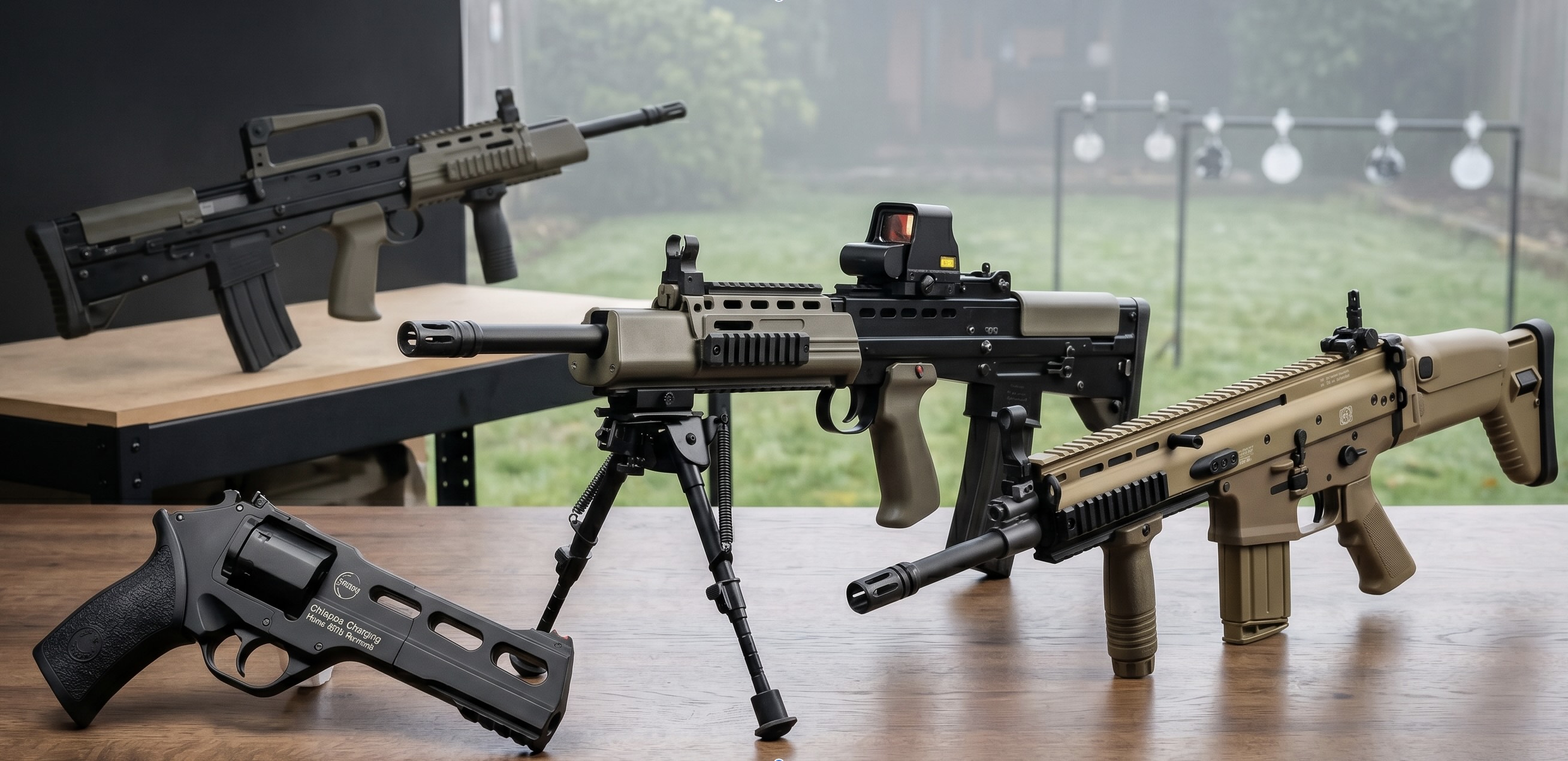
The New Wave of Backyard Plinking: Top 5 Target Replicas in Stock for 2026
 May 13, 2026
FAQs
1. What is a BB gun used for? BB guns are mostly used for practice shooting and training. The stronger ones (i.e. Air Rifles) can also control pests or hunt small animals.
2. Do you need a Licence in the UK for a BB gun? No, you don't need a licence for a BB gun in the UK, but there are rules. The BB Gun needs to be in two colours; one has to be a primary. All our guns are on the website as per default.
3. Is a BB gun a good weapon? BB guns, despite sometimes being seen as toys, can be dangerous. They fire pellets at high speeds and can cause serious harm, or even be deadly in some situations.
4. Can you shoot BB guns in public in the UK without a Firearm license? BB guns in the UK navigate a legal grey area. While certain models, notably low-power 'soft air' types, typically evade classification as section 1 firearms, more potent versions may require a valid firearms certificate to avoid legal repercussions.
5. Can you shoot a BB gun in your garden? You can use a BB gun in your garden under UK law, but you have to ensure the pellets don't go into your neighbour's yard, plot or land. If they do and you don't have permission, it's against the law.
6. Which UK law am I breaking if the pellets go into my neighbour's law without permission? If your BB gun pellets go into your neighbour's yard without permission, you're breaking UK laws. Specifically, the 1968 Firearms Act and possibly the 2003 Anti-Social Behaviour Act, because you may be causing your neighbours trouble or worry.
Discover Our Top Selling BB Gun Guides
Five Best BB Guns Under £30
Discover our five top selling BB guns under £30 guide here.
Five Top Selling Gel Blasters
Discover our top selling Gel Blasters guide here.
Gas guns
Discover our Gas guns guide here.
Toy BB guns
Discover our Toy BB guns guide here.
Five Top Selling BB Guns
Discover our five top selling BB guns of 2026 guide here.
Five Top Selling BB Gun Assault Rifles
Discover our top selling BB gun assault rifles guide here.
Six Top Selling BB Gun Machine Guns
Discover our six top selling full auto BB guns (best BB machine guns to buy) guide here.
Top 6 airsoft pistols
Discover our Top 6 airsoft pistols guide here.